
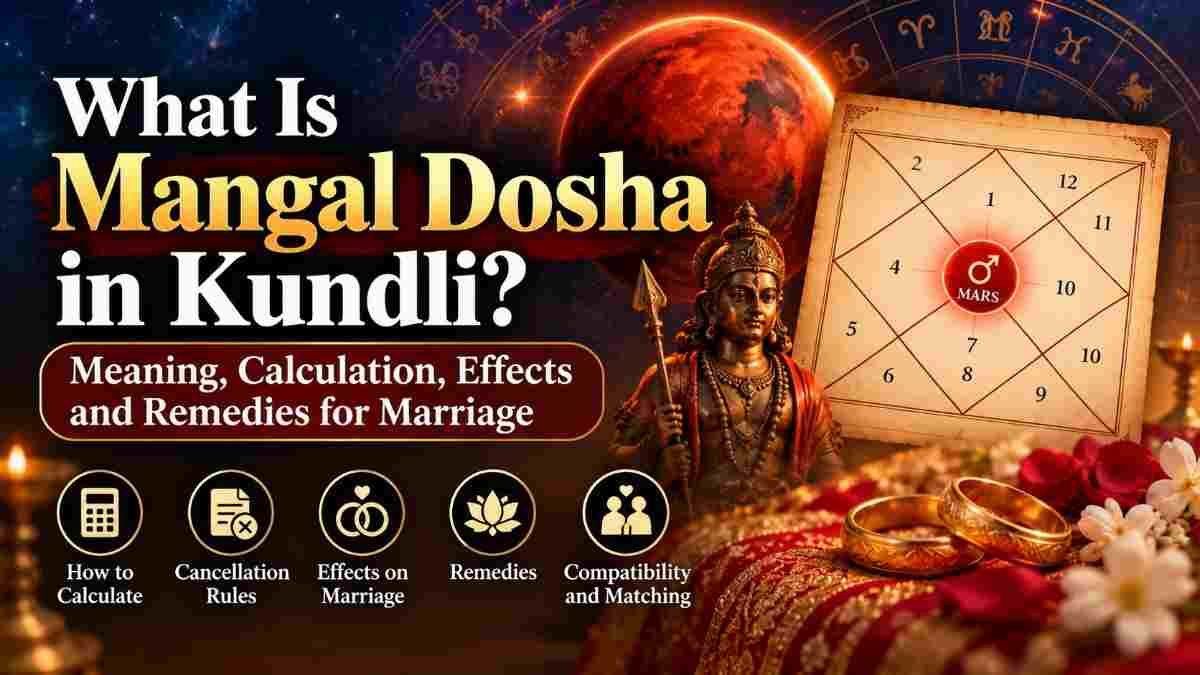
Mangal Dosha, also known as Manglik Dosha or Kuja Dosha, is a traditional concept in Vedic astrology associated with the placement of Mars (Mangal) in certain houses of a birth chart.
In traditional Indian astrology, Mangal Dosha is often discussed during Kundli matching before marriage. Some astrological schools associate particular Mars placements with relationship challenges, disagreements, impatience, or difficulties in marital adjustment.
However, a person should not be considered incompatible for marriage simply because Mars occupies one of the traditionally designated houses.
Mangal Dosha is commonly identified when Mars occupies the 1st, 2nd, 4th, 7th, 8th, or 12th house from the Ascendant, although calculation rules vary between Vedic astrology traditions. Some methods also examine Mars from the Moon and Venus.
This guide explains what Mangal Dosha means, how it is traditionally calculated, what different Mars placements signify, and how cancellation rules and marriage compatibility are interpreted.
If you are unfamiliar with identifying houses and planetary placements, learning the fundamentals of Kundli reading and Vedic astrology can provide useful background before exploring Manglik Dosha.
Mangal Dosha is an astrological classification based on Mars occupying certain houses in a birth chart.
Mars is traditionally associated with energy, courage, initiative, determination, competition, and assertiveness.
These qualities are not inherently negative. In Vedic astrology, their interpretation depends on the house, zodiac sign, planetary aspects, and other chart factors.
Some traditional schools associate particular Mars placements with challenges involving marriage or close relationships. This association is the basis of Manglik Dosha.
However, Vedic astrology is a traditional belief system, and there is no scientific evidence that Mars placements determine marital success or relationship outcomes.
One commonly used Manglik Dosha calculation method examines whether Mars occupies any of the following houses from the Ascendant:
Not all astrologers use identical rules. Some traditions exclude the second house, apply different exceptions, or evaluate additional reference points.
The following table outlines common symbolic interpretations.
| Mars Placement | Traditional House Significance | Common Astrological Interpretation |
|---|---|---|
| 1st House | Identity, behavior, temperament | Strong initiative and assertiveness; possible interpersonal friction |
| 2nd House | Family, speech, resources | Communication and family-related themes |
| 4th House | Home, comfort, domestic life | Domestic expectations and emotional adjustment |
| 7th House | Marriage and partnerships | Relationship dynamics and partnership expectations |
| 8th House | Shared resources, change, intimacy | Trust, adjustment, and shared responsibilities |
| 12th House | Privacy, expenditure, withdrawal | Personal space, spending, and intimacy-related themes |
These interpretations are symbolic associations used in astrology, not guaranteed effects of planetary positions.
Calculating Manglik Dosha requires identifying Mars in the birth chart and counting its position from the relevant reference point.
Locate the Lagna or Ascendant in your Janam Kundli.
The Ascendant establishes the first house in a commonly used whole-sign Vedic chart.
For example, if Aries is the Ascendant, Aries becomes the first house, Taurus the second, Gemini the third, and so on.
Locate Mars, usually labelled Mangal, Mars, or Ma in the Kundli.
Identify the zodiac sign and house containing Mars.
Be careful when reading different chart formats. North Indian charts typically keep house positions fixed, while South Indian charts generally keep zodiac signs fixed.
Using the common six-house method, Mars in the 1st, 2nd, 4th, 7th, 8th, or 12th house is considered a potential Manglik Dosha placement.
For example, consider a hypothetical Aries Ascendant birth chart.
If Mars is placed in Libra, it occupies the seventh house in a whole-sign chart.
Under the common Manglik calculation method, this placement meets the basic condition for Mangal Dosha.
However, the complete traditional assessment may consider Mars's sign, aspects, conjunctions, planetary strengths, and cancellation conditions.
Some Vedic astrology traditions examine Mars not only from the Ascendant but also from the Moon sign.
In this approach, the Moon's sign becomes the first reference position, and the house containing Mars is counted from there.
For example, if the Moon is in Taurus and Mars is in Leo, Mars is fourth from the Moon in sign-based counting.
Under a method that includes the fourth position, this may be treated as a Manglik indicator from the Moon.
This calculation does not necessarily mean that every astrologer will give the same final assessment.
Some astrologers include Venus as another reference point because Venus is traditionally associated with relationships and marriage-related significations.
In those approaches, Mars's position is examined from the Venus sign as well.
However, the relative importance given to Lagna, Moon, and Venus varies across astrological schools.
For this reason, online Manglik calculators using different rules may occasionally produce different results.
In common astrological terminology, a person is described as Manglik when their birth chart meets the selected traditional conditions for Mangal Dosha.
A person whose chart does not meet those conditions is generally described as non-Manglik under that particular method.
The distinction is an astrological classification, not a measurement of personality, character, relationship quality, or suitability for marriage.
Someone classified as Manglik can have a stable relationship, just as someone classified as non-Manglik can experience relationship difficulties.
Real relationship outcomes depend on communication, compatibility, trust, behavior, life circumstances, and many other factors.
No. Even within traditional Vedic astrology, Manglik Dosha is not universally interpreted as guaranteeing marital difficulties.
Many schools consider mitigating or cancellation conditions, the complete seventh-house configuration, and other marriage-related chart factors.
The presence of Mars in a designated house is only one element of a broader traditional interpretation.
Common traditional themes associated with Mangal Dosha include:
These themes should not be confused with inevitable outcomes.
Couples facing practical compatibility concerns can also explore Astro Aashirvaad's love marriage and relationship guidance, which is relevant to understanding relationship expectations and family concerns.
The seventh house is traditionally associated with marriage, long-term partnerships, and one-to-one relationships.
When Mars occupies the seventh house, some Vedic astrology approaches associate it with assertiveness, strong opinions, initiative, or conflict-related themes in partnerships.
However, Mars in the seventh house alone does not establish that a marriage will be unsuccessful.
A traditional astrologer may also examine the seventh-house lord, Venus, Jupiter, relevant aspects, and divisional charts.
Outside astrology, healthy relationships depend on mutual respect, communication, emotional safety, and the ability to manage disagreements constructively.
The eighth house is traditionally associated with transformation, shared resources, hidden matters, and major changes.
Some astrological traditions connect Mars in the eighth house with intense or challenging relationship themes.
However, this placement does not reliably predict separation, injury, loss, or the lifespan of a spouse.
Fear-based conclusions based on one planetary placement should be avoided.
The correct approach within traditional astrology is to examine the complete chart and recognize the limitations of interpretation.
Mangal Dosha cancellation is commonly called Mangal Dosha Nivaran or Manglik Dosha cancellation.
Different Vedic astrology schools describe various conditions that may reduce or cancel the traditional significance assigned to a Manglik placement.
These rules are not applied uniformly across every tradition.
Some traditional rules consider whether Mars occupies its own signs, Aries or Scorpio, or its exaltation sign, Capricorn.
Specific house-and-sign combinations are sometimes treated as exceptions or mitigating conditions.
However, being in an own or exaltation sign should not automatically be assumed to cancel every form of Manglik Dosha.
Some astrologers consider favorable influences from Jupiter when assessing the severity of a traditional Manglik condition.
Jupiter is associated with wisdom, guidance, and expansion in Vedic astrology.
Its aspects or conjunctions may be interpreted as mitigating factors in certain systems.
Whether this constitutes complete cancellation depends on the rules followed by the astrologer.
One common marriage-matching belief is that Manglik classifications in both partners' charts may balance or mitigate the traditionally assigned effects.
This is not a universal rule, and astrologers differ in how they assess such combinations.
Being classified as Manglik does not mean someone must marry another person classified as Manglik.
A popular claim suggests that Mangal Dosha automatically ends after age 28.
However, this is not a universally accepted rule across Vedic astrology traditions.
Some practitioners discuss maturity or age-related interpretations, but there is no consistent basis for claiming that every Manglik classification disappears at a specific age.
Age alone should not determine marriage decisions.
Some astrologers use informal categories such as mild, moderate, or strong Manglik Dosha.
These descriptions may depend on:
There is no single universally standardized scoring system for the severity of Mangal Dosha.
Consequently, two astrologers may classify the same chart differently.
In traditional Indian astrology, Kundli matching may include Manglik Dosha assessment alongside Ashtakoota or Guna Milan.
Guna Milan commonly compares eight compatibility categories, with a total of 36 points in the traditional system.
Mangal Dosha is a separate consideration and should not be confused with the 36-point score.
| Factor | Traditional Purpose |
|---|---|
| Mangal Dosha | Evaluates selected Mars placements associated with marriage-related themes |
| Guna Milan | Compares eight traditional compatibility categories |
| Seventh House | Examines symbolic partnership and marriage themes |
| Venus and Jupiter | Considered relationship-related significators in several traditional approaches |
| Navamsa (D9) | Used in advanced traditional chart interpretation |
Neither Manglik classification nor Guna Milan scores have been scientifically demonstrated to predict marital success.
If you are researching marriage compatibility, Astro Aashirvaad's marriage and relationship consultation information may help you understand the traditional guidance offered and the importance of practical communication.
Yes. There is no scientific or medical reason why a person classified as Manglik cannot marry someone classified as non-Manglik.
Within traditional astrology, opinions about this pairing vary.
Some astrologers recommend examining the complete birth charts before drawing conclusions, while others place different levels of importance on Manglik compatibility.
Marriage decisions should consider:
Astrological classifications should not be used to shame, pressure, or discriminate against prospective partners.
Various religious and astrological traditions suggest rituals or practices associated with Mangal Dosha.
These practices are matters of personal belief and cultural tradition rather than scientifically established methods of changing future outcomes.
Some Hindu devotional traditions associate Hanuman worship and recitation of the Hanuman Chalisa with practices recommended for Mars-related concerns.
People may follow these practices for spiritual comfort and personal reflection.
Mangal Mantra Jaap refers to the repetition of traditional mantras associated with Mars.
The specific mantra, ritual process, and number of repetitions vary by spiritual and astrological tradition.
Such practices should be approached as devotional activities rather than guaranteed remedies for marriage difficulties.
Mangal Shanti Puja is a ritual performed in some traditions for concerns associated with Mars in a birth chart.
Its procedures differ according to regional customs and religious practices.
No puja can be guaranteed to change someone's relationship outcome.
Some astrological traditions associate red coral with Mars.
However, there is no scientific evidence that wearing a gemstone can remove Mangal Dosha or improve marriage compatibility.
Expensive gemstone purchases should not be made out of fear or under pressure.
No one should feel compelled to participate in a ritual or pay for a service because of frightening claims about their birth chart.
Before choosing a spiritual practice, understand its cultural significance, expected costs, and whether participation reflects your own beliefs.
Many astrology websites and applications provide automated Manglik Dosha calculations.
These tools usually ask for:
The software calculates Mars's chart position and applies its selected Manglik rules.
However, results may vary because different platforms use different calculation methods, house systems, and cancellation rules.
Before relying on a result, check whether the platform explains which houses and reference points it uses.
For readers who want more background on traditional chart interpretation, Astro Aashirvaad's Kundli analysis and astrology guidance page provides context about individual consultations.
Several popular beliefs about Mangal Dosha are presented more definitively than the underlying traditions support.
No. A planetary position cannot reliably predict divorce, and there is no scientific evidence connecting Manglik status with inevitable relationship failure.
There is no credible scientific evidence supporting this claim. Such fear-based predictions should not be treated as factual.
No. Traditional Manglik calculations identify particular houses, and even those rules vary by school.
No. Mars placement does not scientifically determine aggression or temperament. Personality is shaped by many biological, psychological, and environmental factors.
A basic traditional classification can be calculated from Mars's position, but a broader astrological interpretation involves additional chart factors.
If you decide to seek a traditional astrology consultation, asking clear questions can help you understand the method being used.
A responsible consultation should explain its traditional reasoning without guaranteeing events or using fear to encourage unnecessary purchases.
Mangal Dosha is a traditional Vedic astrology classification associated with Mars occupying particular houses in a birth chart. It is commonly discussed in the context of marriage matching.
Many astrologers examine Mars in the 1st, 2nd, 4th, 7th, 8th, and 12th houses. Some traditions use different house combinations or additional conditions.
Identify Mars in your Kundli and check its position against the rules used by the selected astrological system. Some approaches also examine Mars from the Moon and Venus.
No. Even within traditional astrology, the interpretation depends on several chart factors. Mars also has symbolic associations with courage, initiative, and determination.
Yes. Some astrological traditions even regard certain Manglik combinations as mitigating factors. However, real-world marital compatibility depends on the people involved, not an astrological label.
Yes. There is no scientific basis for prohibiting such a marriage. Decisions should be based on consent, compatibility, shared expectations, and the couple's own choices.
There is no universally accepted traditional rule or scientific basis establishing automatic cancellation at age 28.
Some traditional schools consider certain Jupiter influences mitigating, but their rules vary. A Jupiter aspect should not automatically be described as a universal cancellation.
The terms are commonly used interchangeably. Both refer to the traditional astrological classification associated with selected Mars placements.
No. Rituals, mantras, gemstones, and other remedies may hold spiritual or cultural significance, but there is no scientific evidence that they remove astrological doshas or determine marriage outcomes.
Mangal Dosha is a traditional concept used in Vedic astrology to interpret selected placements of Mars in a birth chart.
Although some astrological schools associate these placements with marriage-related themes, the rules, exceptions, and interpretations vary considerably.
The presence of Mangal Dosha should never be treated as proof that a person will experience relationship problems or that a marriage cannot succeed.
For couples planning marriage, trust, communication, shared values, and mutual respect are more meaningful foundations for a healthy relationship.
Those who wish to explore the cultural and traditional interpretation of their birth charts can review Astro Aashirvaad's astrology consultation information.
For questions about available services or the consultation process, contact Astro Aashirvaad directly.
Listen to real experiences from our clients as they share their personal journeys of overcoming life's deepest obstacles. From breaking free of toxic negative energies with expert black magic removal to restoring broken relationship bonds through protective spiritual solutions, these heartfelt testimonials showcase the profound impact of genuine guidance.
My relationship was on the verge of breaking up completely due to severe misunderstandings and intense family opposition regarding our love marriage. I felt utterly helpless until I sought guidance here. The specialized love problem solutions and planetary alignments completely shifted the energy. Today, my partner and I are happily married with our families' full blessings. Truly a life-saving experience!
Rahul Sharma, Delhi

For over a year, our home felt incredibly heavy, and my health was deteriorating for no medical reason. We were facing constant, unexplained financial blockages. After a deep spiritual analysis, we discovered presence of strong negative energies. The black magic removal rituals performed brought immediate peace back into our house. Within a week, the heavy atmosphere vanished, and my health restored completely.
Priya Patel, Mumbai
Constant arguments and third-party interference had ruined my married life to the point where we were discussing legal separation and divorce. Out of desperation, I tried the relationship healing and cosmic balancing remedies. The results were miraculous. The bitterness between my husband and me completely dissolved, reviving our original love and mutual respect. I cannot thank you enough for saving my family.
Anjali Desai, Ahmedabad
My business went into a sudden, massive downfall out of nowhere, leaving me drowning in debt. I couldn't understand what went wrong until my birth chart was analyzed and malefic planetary transits were identified. The custom gemstone recommendations and business progress rituals turned everything around. My client flow is back, and the business is growing faster than ever before.
Vikram Malhotra, Bangalore
Our family was torn apart by a bitter property and relationship dispute that dragged on for years, causing immense stress to everyone involved. The peaceful energy alignment and ancestral cleansing solutions worked wonders. Within a short time, minds softened, communication lines reopened, and the entire dispute was resolved amicably. It brought genuine harmony back to our lives.
Sandeep Joshi, Jaipur

