
Have you heard astrologers mention the Navamsa chart when discussing marriage, compatibility, or your future spouse? The D9 chart is an important part of traditional Vedic astrology, but its meaning is often misunderstood.
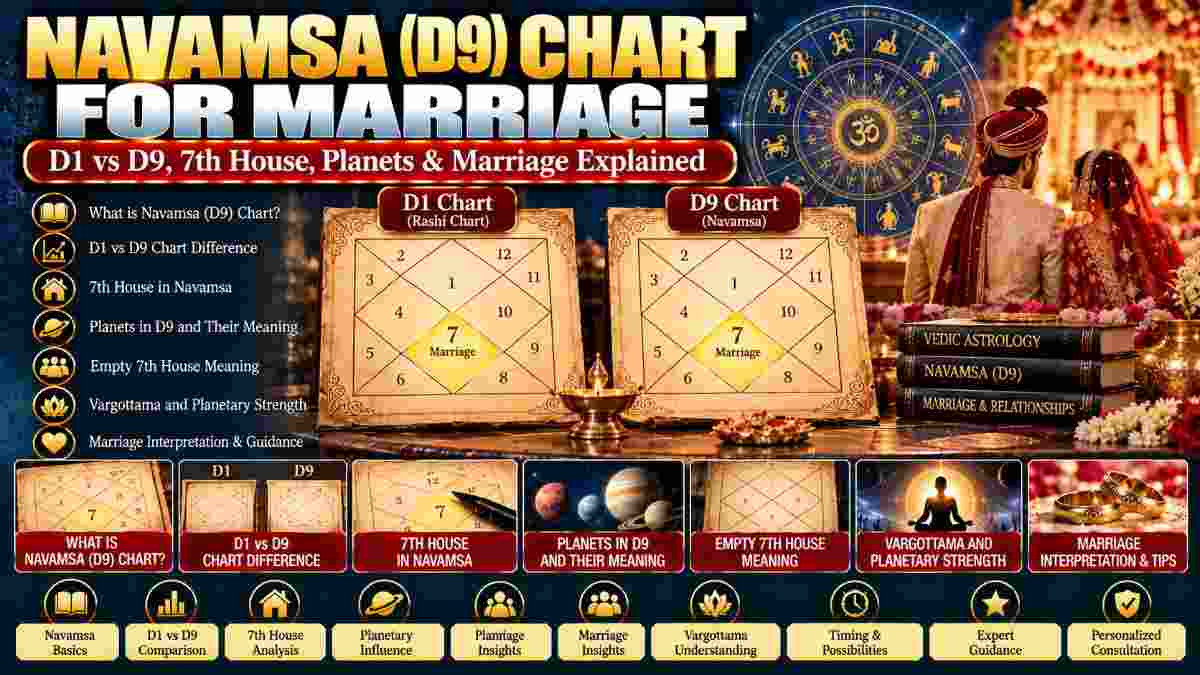
The Navamsa chart for marriage is a divisional birth chart traditionally used to examine partnerships, planetary strength, and marriage-related themes alongside the main Kundli.
At Astro Aashirvaad, individuals interested in Vedic astrology can explore traditional birth-chart interpretations for personal reflection and relationship guidance.
The Navamsa, also called the D9 chart, is created by dividing each zodiac sign into nine equal sections of 3 degrees and 20 minutes.
The term Navamsa refers to a ninth division.
It is one of the divisional charts, or Vargas, used in Jyotish.
Traditional astrologers commonly examine it for:
Marriage and partnerships.
Planetary dignity.
Relationship themes.
Personal values.
Spiritual development.
Interpretations of long-term commitment.
The Navamsa complements the main birth chart rather than replacing it.
The D1 chart represents the main birth chart, while the D9 chart provides a traditional divisional perspective based on the planetary positions within each zodiac sign.
The D1 chart, also called the Rashi chart, is used for general birth-chart interpretation.
The D9 chart is traditionally consulted for additional insight into planetary dignity and marriage-related themes.
Both charts are calculated from the same birth information.
An astrologer generally examines them together.
The Navamsa is calculated by dividing each 30-degree zodiac sign into nine sections, each measuring 3°20′, and assigning those sections to specific zodiac signs according to traditional rules.
The calculation uses:
Date of birth.
Time of birth.
Place of birth.
Calculated planetary positions.
Ascendant position.
The D9 chart is then constructed from these divisions.
Accurate birth information is important because small timing differences can change the Navamsa Ascendant.
Traditional Vedic astrology associates the Navamsa with marriage, partnership dynamics, and the interpretation of planetary strength.
Astrologers may examine the D9 chart to discuss themes such as:
Commitment.
Emotional understanding.
Cooperation.
Relationship expectations.
Personal values.
Long-term partnership.
However, the chart cannot reliably predict whether a marriage will succeed.
Healthy relationships depend on communication, respect, compatibility, and mutual effort.
The seventh house in the D9 chart is traditionally associated with marriage, spouses, and committed partnerships.
Astrologers may examine its zodiac sign, ruling planet, and planetary placements.
The interpretation is generally considered alongside the seventh house of the main birth chart.
A single placement should not be treated as proof of marriage problems or marital happiness.
The seventh house lord is the planet ruling the sign occupying the seventh house of the Navamsa chart.
Traditional interpretations consider:
The ruling planet's sign.
Its house placement.
Planetary dignity.
Relationships with other planets.
Relevant factors in the D1 chart.
No single seventh-lord placement determines a person's relationship future.
Venus and Jupiter are traditionally examined as relationship-related significators, with interpretations depending on the broader chart and astrological tradition.
Venus is commonly associated with affection, harmony, attraction, and partnership.
Jupiter is associated with wisdom, values, guidance, and growth.
Their positions in the D9 chart may be discussed symbolically during a consultation.
These meanings are part of astrological tradition rather than scientifically established personality measures.
An empty seventh house means no planet occupies that house in the D9 chart; it does not mean marriage is impossible or unsuccessful.
Many charts contain empty houses.
Traditional astrologers may instead examine the seventh house lord and other relevant placements.
An empty house should not automatically be interpreted negatively.
Vargottama refers to a planet occupying the same zodiac sign in both the D1 and D9 charts.
In traditional astrology, this is considered a noteworthy planetary condition.
However, Vargottama does not automatically mean that every area associated with the planet will produce favorable results.
Its interpretation depends on the wider chart.
The D9 chart cannot reliably predict an exact marriage date or establish whether someone will marry.
Some traditional astrologers also examine Mahadasha, Antardasha, and planetary transits when discussing timing.
These methods are part of an interpretive belief system and have not been scientifically demonstrated to forecast marriage events.
Personal circumstances and individual decisions remain more relevant to real-world planning.
Accurate birth time is important because the D9 Ascendant can change with relatively small differences in birth time.
An uncertain birth time may change the house structure used in a traditional interpretation.
Before arranging a reading:
Check your recorded birth time.
Confirm the birthplace.
Avoid estimating the time without mentioning the uncertainty.
Ask the practitioner to explain how uncertainty affects the chart.
A responsible interpretation should acknowledge limitations in the information provided.
Navamsa analysis and Kundli matching serve different purposes within traditional astrology, and neither reliably measures real-world marital compatibility.
Navamsa is derived from an individual's birth chart.
Kundli matching compares traditional indicators across two birth charts.
Practical compatibility should also consider:
Shared values.
Communication.
Emotional maturity.
Mutual respect.
Financial expectations.
Future goals.
Explore Love Marriage Guidance for additional relationship-related information.
Common mistakes include treating D9 as an independent prediction tool, ignoring birth-time accuracy, and drawing conclusions from individual planets.
Avoid:
Judging marriage from one placement.
Assuming an empty seventh house is unfavorable.
Treating planetary dignity as a guarantee.
Ignoring the main birth chart.
Assuming D9 activates only after marriage.
Using astrological readings to pressure relationship decisions.
A balanced interpretation acknowledges uncertainty and personal choice.
Ask questions that help you understand the traditional interpretation without treating it as a fixed prediction.
Useful questions include:
How was my D9 chart calculated?
Is my recorded birth time sufficiently accurate?
What is my Navamsa Ascendant?
How is the seventh house interpreted?
What role do Venus and Jupiter play?
How are my D1 and D9 charts compared?
What limitations should I understand?
Common questions concern D9 calculation, seventh-house interpretations, marriage compatibility, and planetary positions.
No. Traditional astrology also uses it to interpret planetary dignity, values, and spiritual themes.
No. Astrological placements cannot guarantee relationship outcomes.
No. The D9 chart is calculated from birth details and does not change when someone gets married.
A D9 chart can be calculated separately, but traditional practitioners generally interpret it alongside the main birth chart.
Astrologers may provide symbolic interpretations, but the chart cannot reliably identify or describe a future partner.
You can seek a traditional Vedic astrology consultation to understand how the Navamsa chart, seventh house, and planetary placements are interpreted within Jyotish.
Prepare your birth date, recorded birth time, birthplace, and questions before the consultation.
Explore Love Marriage Guidance or contact Astro Aashirvaad for consultation information.
Disclaimer: Astrology is a traditional belief-based practice and should not replace personal judgment, qualified relationship counseling, or informed marriage decisions.
Listen to real experiences from our clients as they share their personal journeys of overcoming life's deepest obstacles. From breaking free of toxic negative energies with expert black magic removal to restoring broken relationship bonds through protective spiritual solutions, these heartfelt testimonials showcase the profound impact of genuine guidance.
My relationship was on the verge of breaking up completely due to severe misunderstandings and intense family opposition regarding our love marriage. I felt utterly helpless until I sought guidance here. The specialized love problem solutions and planetary alignments completely shifted the energy. Today, my partner and I are happily married with our families' full blessings. Truly a life-saving experience!
Rahul Sharma, Delhi

For over a year, our home felt incredibly heavy, and my health was deteriorating for no medical reason. We were facing constant, unexplained financial blockages. After a deep spiritual analysis, we discovered presence of strong negative energies. The black magic removal rituals performed brought immediate peace back into our house. Within a week, the heavy atmosphere vanished, and my health restored completely.
Priya Patel, Mumbai
Constant arguments and third-party interference had ruined my married life to the point where we were discussing legal separation and divorce. Out of desperation, I tried the relationship healing and cosmic balancing remedies. The results were miraculous. The bitterness between my husband and me completely dissolved, reviving our original love and mutual respect. I cannot thank you enough for saving my family.
Anjali Desai, Ahmedabad
My business went into a sudden, massive downfall out of nowhere, leaving me drowning in debt. I couldn't understand what went wrong until my birth chart was analyzed and malefic planetary transits were identified. The custom gemstone recommendations and business progress rituals turned everything around. My client flow is back, and the business is growing faster than ever before.
Vikram Malhotra, Bangalore
Our family was torn apart by a bitter property and relationship dispute that dragged on for years, causing immense stress to everyone involved. The peaceful energy alignment and ancestral cleansing solutions worked wonders. Within a short time, minds softened, communication lines reopened, and the entire dispute was resolved amicably. It brought genuine harmony back to our lives.
Sandeep Joshi, Jaipur

