
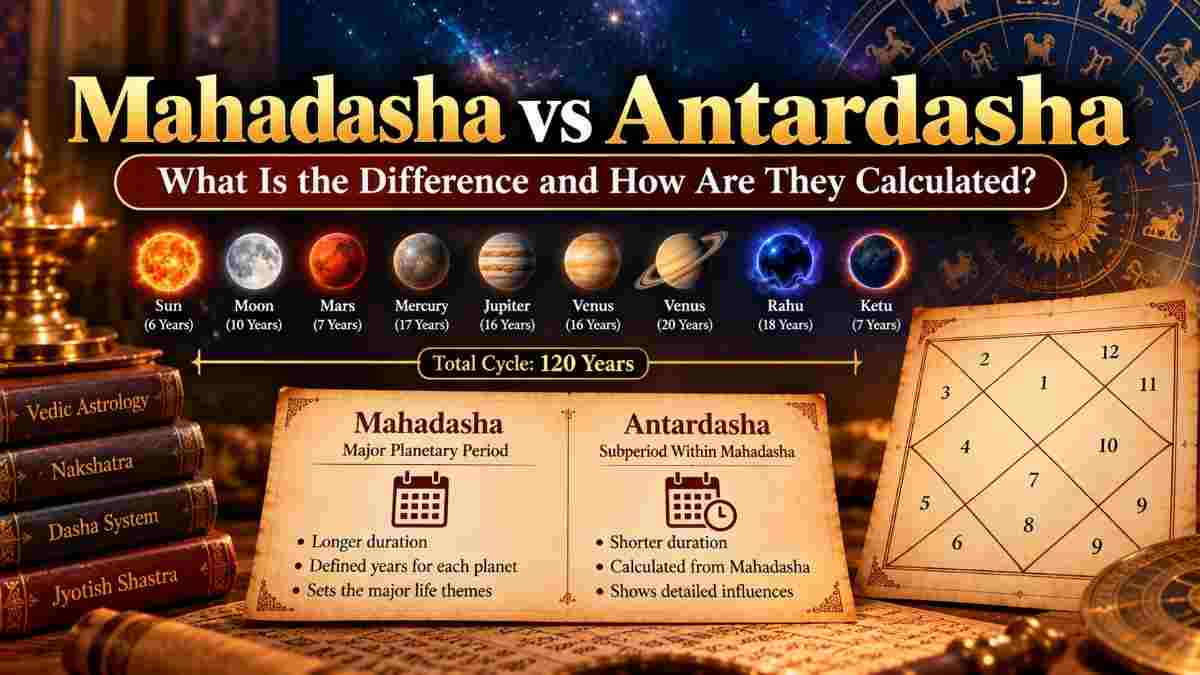
Mahadasha and Antardasha are two important concepts in traditional Vedic astrology. Both belong to planetary period systems used to interpret different stages of life according to an individual's birth chart.
When studying Kundli reading, you may encounter terms such as Shani Mahadasha, Rahu Mahadasha, Jupiter Antardasha, or Venus Antardasha. These terms refer to different levels of planetary periods rather than planetary positions in the birth chart.
The main difference between Mahadasha and Antardasha is that Mahadasha represents a major planetary period, while Antardasha represents a smaller planetary subperiod within that Mahadasha.
In the widely used Vimshottari Dasha system, nine grahas collectively rule a traditional 120-year cycle. Each major period is subdivided into Antardashas, allowing astrologers to examine shorter intervals within a larger planetary period.
This guide explains Mahadasha vs Antardasha, their traditional meanings, planetary durations, calculation formulas, worked examples, and common questions about dasha interpretation.
If you are new to Vedic astrology, understanding the Ascendant, planets, and houses is a useful starting point. You can explore Astro Aashirvaad's Vedic astrology blog resources before moving into advanced planetary period calculations.
Mahadasha is the major planetary period within a traditional Vedic astrology dasha system.
In Vimshottari Dasha, each of the nine grahas is assigned a specific number of years. These planetary periods follow a fixed sequence.
For example, the traditional duration of Jupiter Mahadasha is 16 years, while Saturn Mahadasha lasts 19 years.
During a Mahadasha, astrologers traditionally examine the planet ruling that period, its placement in the birth chart, its house lordships, and its relationships with other planets.
The resulting interpretations may address symbolic themes related to career, education, relationships, financial responsibilities, and personal development.
However, planetary periods are part of an astrological belief system. They are not scientifically established methods for predicting individual life events.
Antardasha is a planetary subperiod that operates within a Mahadasha.
Every Mahadasha is divided into nine Antardashas under the Vimshottari system, one associated with each graha.
For example, a person experiencing Jupiter Mahadasha may pass through Jupiter Antardasha, Saturn Antardasha, Mercury Antardasha, and other planetary subperiods.
These subperiods are traditionally used to examine narrower intervals within the larger Mahadasha.
The Mahadasha planet establishes the major period, while the Antardasha planet provides an additional layer of symbolic interpretation.
Mahadasha and Antardasha are related but serve different roles in Vimshottari Dasha calculations.
| Feature | Mahadasha | Antardasha |
|---|---|---|
| Meaning | Major planetary period | Subperiod within a Mahadasha |
| Duration | Fixed traditional duration assigned to each graha | Calculated as a fraction of the parent Mahadasha |
| Planetary Ruler | One principal period ruler | One subperiod ruler |
| Traditional Purpose | Broader period interpretation | More detailed interpretation within that period |
| Sequence | Follows the nine-graha Vimshottari order | Begins with the Mahadasha ruler and follows the same cyclic order |
| Example | Saturn Mahadasha | Saturn–Venus Antardasha |
| Calculation | Based on prescribed planetary durations and birth Nakshatra balance | Derived from the Mahadasha and Antardasha planetary durations |
In simple terms, Mahadasha is the larger period, and Antardasha is one of its subdivisions.
Vimshottari Dasha is one of the most widely used planetary period systems in Vedic astrology.
The word Vimshottari refers to 120, representing the sum of the nine traditional planetary period durations.
The system assigns a fixed number of years to each graha.
These periods follow a repeating sequence and are traditionally calculated using the Moon's Nakshatra at birth.
The 120-year total is a mathematical feature of the astrological system, not a prediction that every person will live for 120 years.
The traditional Vimshottari sequence and planetary durations are shown below.
| Planet | Mahadasha Duration | Sequence |
|---|---|---|
| Ketu | 7 years | 1 |
| Venus (Shukra) | 20 years | 2 |
| Sun (Surya) | 6 years | 3 |
| Moon (Chandra) | 10 years | 4 |
| Mars (Mangal) | 7 years | 5 |
| Rahu | 18 years | 6 |
| Jupiter (Guru) | 16 years | 7 |
| Saturn (Shani) | 19 years | 8 |
| Mercury (Budh) | 17 years | 9 |
| Total | 120 years | Complete cycle |
Once Mercury's period is completed, the sequence returns to Ketu.
However, a person's first Mahadasha at birth does not always begin with Ketu. It depends on the ruling planet of the Moon's birth Nakshatra.
In the standard Nakshatra-based Vimshottari system, the starting Mahadasha is determined by the Moon's position within one of the 27 Nakshatras.
Each Nakshatra spans 13 degrees and 20 minutes of the zodiac.
The ruling graha of the Nakshatra containing the Moon becomes the starting Mahadasha ruler.
The portion of that Nakshatra remaining at birth determines the remaining balance of the first Mahadasha.
First, calculate the Moon's sidereal zodiacal longitude using the birth date, birth time, birthplace, and a selected ayanamsa.
Identify the Nakshatra occupied by the Moon.
For example, Ashwini Nakshatra is traditionally ruled by Ketu, while Bharani Nakshatra is ruled by Venus.
The Nakshatra ruler determines which Mahadasha is operating at the time of birth.
The remaining duration of the first Mahadasha is proportional to the portion of the Moon's Nakshatra that has not yet been traversed.
The basic formula is:
Remaining Mahadasha = (Remaining Nakshatra Arc / Total Nakshatra Arc) × Full Mahadasha Duration
Every standard Nakshatra spans 13 degrees and 20 minutes.
As a hypothetical example, suppose the Moon is positioned so that 40% of its Nakshatra remains, and the Nakshatra is ruled by Jupiter.
Jupiter's complete Vimshottari Mahadasha duration is 16 years.
Remaining Jupiter Mahadasha = 40% × 16 years
Remaining Jupiter Mahadasha = 6.4 dasha years
This is the remaining Jupiter Mahadasha balance from birth under the simplified calculation.
Actual calendar dates depend on the calculation convention and software settings used.
After the remaining birth Mahadasha has elapsed, the next graha in the Vimshottari sequence begins its full major period.
For example, Jupiter is followed by Saturn, then Mercury, Ketu, Venus, and so on.
This means the timing of different Mahadashas depends on both the starting Nakshatra and the remaining balance at birth.
Antardasha duration is calculated using the durations assigned to the Mahadasha ruler and the Antardasha ruler.
The traditional proportional formula is:
Antardasha Duration = (Mahadasha Planet Years × Antardasha Planet Years) / 120
The result is expressed in dasha years.
For example, Venus Mahadasha lasts 20 years, and Saturn's assigned Mahadasha duration is 19 years.
The duration of Saturn Antardasha within Venus Mahadasha is therefore calculated as follows:
Venus–Saturn Antardasha = (20 × 19) / 120
= 380 / 120
= 3.1667 dasha years
Under a traditional 360-day dasha-year convention, this corresponds to approximately three years and two 30-day months.
Some astrology software uses different conventions to map planetary periods to civil calendar dates. Therefore, exact start and end dates should be checked using a consistent calculation method.
Consider another example involving Venus Mahadasha and Sun Antardasha.
Venus Mahadasha duration = 20 years
Sun's Vimshottari period duration = 6 years
Using the formula:
Venus–Sun Antardasha = (20 × 6) / 120
= 1 dasha year
This example shows how the same Mahadasha contains subperiods of different lengths depending on the assigned duration of the Antardasha ruler.
Every Mahadasha begins with the Antardasha of its own ruling planet.
The remaining Antardashas follow the established Vimshottari planetary order.
Rahu Mahadasha lasts 18 years and contains the following Antardashas:
| Rahu Mahadasha Subperiod | Approximate Duration in Dasha Years |
|---|---|
| Rahu–Rahu | 2.70 |
| Rahu–Jupiter | 2.40 |
| Rahu–Saturn | 2.85 |
| Rahu–Mercury | 2.55 |
| Rahu–Ketu | 1.05 |
| Rahu–Venus | 3.00 |
| Rahu–Sun | 0.90 |
| Rahu–Moon | 1.50 |
| Rahu–Mars | 1.05 |
| Total | 18.00 |
For example, Rahu–Venus Antardasha lasts three dasha years because:
(18 × 20) / 120 = 3
The same proportional formula applies to the other planetary subperiods.
In traditional Vedic astrology, Mahadasha and Antardasha are interpreted together rather than independently.
The Mahadasha ruler represents the broader symbolic period, while the Antardasha ruler is examined for additional themes within that interval.
Traditional interpretations may consider:
For example, during Jupiter Mahadasha and Venus Antardasha, astrologers may examine the symbolic roles of Jupiter and Venus alongside their house placements in the individual's birth chart.
However, the existence of a particular planetary combination cannot reliably determine whether specific events will occur.
Both periods are important within the traditional Vimshottari framework, but they operate at different levels.
The Mahadasha provides the larger period structure, while the Antardasha divides that structure into more specific intervals.
Some advanced interpretations also use further subdivisions such as Pratyantardasha.
It is therefore misleading to interpret an Antardasha without considering the Mahadasha within which it occurs.
Vimshottari Dasha can be divided into several levels of planetary periods.
| Period | Meaning | Relationship |
|---|---|---|
| Mahadasha | Major planetary period | Main period within the 120-year cycle |
| Antardasha | Subperiod | Subdivision of a Mahadasha |
| Pratyantardasha | Sub-subperiod | Subdivision of an Antardasha |
| Sookshma Dasha | Further subdivision | Smaller interval within a Pratyantardasha |
The calculation follows the same proportional structure at each level.
For example, the duration of a Pratyantardasha is calculated by multiplying the parent Antardasha duration by the next planet's assigned years and dividing by 120.
Beginners should understand Mahadasha and Antardasha before studying these more detailed subdivisions.
Mahadasha and planetary transit are different concepts in Vedic astrology.
Mahadasha refers to a calculated planetary period derived from the birth Nakshatra within a dasha system.
Transit, or Gochar, refers to the current astronomical position of a planet compared with a birth chart or another reference point.
| Feature | Mahadasha | Planetary Transit |
|---|---|---|
| Basis | Birth chart and dasha calculations | Changing planetary positions |
| Duration | Assigned major planetary period | Depends on planetary movement |
| Starting Point | Often Moon's birth Nakshatra | Actual transit positions |
| Traditional Use | Planetary period interpretation | Interpretation of ongoing planetary movements |
Traditional astrologers may consider both concepts together, although neither is scientifically established as a predictor of personal events.
Career-related astrology interpretations often examine planetary periods alongside the tenth house, sixth house, second house, and eleventh house.
In traditional symbolism, these houses may be associated with profession, service, resources, and gains.
For example, an astrologer may study the Mahadasha ruler's relationship with the tenth house when discussing professional themes.
However, a planetary period cannot reliably indicate the date of a promotion, salary increase, or job change.
Career decisions are better supported by practical factors such as skill development, employment conditions, financial planning, and professional opportunities.
In traditional marriage-related astrology, some practitioners examine planetary periods alongside the seventh house, Venus, Jupiter, and the Navamsa chart.
These factors form part of an interpretive system used to discuss relationship themes and marriage-related timing.
However, Mahadasha and Antardasha combinations cannot reliably predict when someone will marry or whether a relationship will succeed.
For readers interested in relationship concerns, Astro Aashirvaad provides love marriage and relationship guidance, including information about family objections, communication, and compatibility.
Mutual consent, respect, emotional compatibility, and open communication remain more important for real-world relationship decisions than astrological period classifications.
No. Even within traditional Vedic astrology, Rahu Mahadasha is not automatically interpreted as an unfavorable period.
Rahu is symbolically associated with ambition, unconventional interests, desires, and unfamiliar experiences.
Different astrological schools consider its placement, associations, and relationships with other chart factors.
Popular claims that Rahu Mahadasha always causes instability, loss, or hardship oversimplify the tradition.
There is also no scientific basis for claiming that Rahu periods cause particular life events.
No. Saturn, or Shani, is traditionally associated with discipline, responsibility, patience, structure, and persistence.
Although Saturn is sometimes described in popular astrology as representing delays or challenges, its traditional interpretation depends on the complete chart.
A Saturn Mahadasha should not automatically be treated as a period of failure or suffering.
Likewise, no planetary period guarantees professional success, wealth, or relationship stability.
In traditional astrology, planetary classifications such as benefic and malefic can influence how a Mahadasha–Antardasha combination is interpreted.
However, these labels are not sufficient for a complete reading.
A planet may be considered differently depending on the Ascendant, house rulerships, placement, and the interpretive school being followed.
Therefore, the effects attributed to a planetary subperiod are not determined solely by whether the planet is commonly called benefic or malefic.
Yes. Astrology software can calculate planetary periods using birth data and a selected dasha system.
Most calculations require:
Before comparing results from different platforms, check whether they use the same Vimshottari calculation conventions.
Differences in birth time, Moon longitude, ayanamsa, or year-length conventions can affect displayed dates.
Astro Aashirvaad's astrology consultation and Kundli analysis guidance can also provide background on how traditional birth chart interpretations are discussed.
Different tools may show slightly different planetary period dates because they use different astronomical or calendar settings.
Possible reasons include:
A consistent set of calculation parameters is necessary for meaningful comparison.
If the recorded birth time is uncertain, it may also affect some chart calculations and should be considered carefully.
Beginners sometimes focus on the name of a planetary period without understanding the broader calculation system.
Common mistakes include:
Understanding the calculation method before studying traditional interpretations can prevent many of these errors.
Mahadasha is a major planetary period in traditional Vedic astrology. In Vimshottari Dasha, each graha has a fixed assigned duration within a 120-year cycle.
Antardasha is a smaller planetary period within a Mahadasha. Its duration is calculated proportionally using the assigned periods of the two planets.
Venus Mahadasha is the longest in the standard Vimshottari system, lasting 20 dasha years.
Ketu and Mars have the shortest Mahadasha durations in the standard system, each lasting 7 dasha years.
Every Mahadasha contains nine Antardashas under the standard Vimshottari system, corresponding to the nine grahas.
No. The first Mahadasha depends on the planetary ruler of the Moon's birth Nakshatra. The remaining balance is determined by the Moon's position within that Nakshatra.
Antardasha duration equals the Mahadasha planet's assigned years multiplied by the Antardasha planet's assigned years, divided by 120.
Rahu–Venus Antardasha lasts three dasha years because Rahu's assigned duration is 18 years and Venus's is 20 years: (18 × 20) / 120 = 3.
Astrologers traditionally interpret Mahadasha and Antardasha in relation to life themes, but scientific evidence does not establish these calculations as reliable predictors of marriage, career success, or other specific outcomes.
No. Mahadasha is a calculated planetary period within a dasha system, while Sade Sati is a traditional Saturn transit concept involving Saturn's movement relative to the natal Moon sign.
Yes. Antardasha always occurs within a Mahadasha. For example, someone in Jupiter Mahadasha will also be experiencing one of Jupiter Mahadasha's nine Antardashas.
Understanding Mahadasha and Antardasha begins with learning the Vimshottari Dasha sequence, the Moon's birth Nakshatra, and the formula used to divide major planetary periods into subperiods.
Mahadasha represents the broader planetary period, while Antardasha provides a smaller subdivision within that period.
Both concepts form part of traditional Vedic astrology and are commonly studied alongside zodiac signs, planetary placements, house lordships, and other chart factors.
Although these interpretations have cultural and spiritual significance for many people, they should not be treated as scientifically verified predictions of personal events.
Astro Aashirvaad provides traditional astrology-related information and consultation guidance for readers interested in exploring Kundli concepts and planetary periods.
For questions about available astrology consultation services, you can contact Astro Aashirvaad to enquire about its approach to birth chart analysis.
Listen to real experiences from our clients as they share their personal journeys of overcoming life's deepest obstacles. From breaking free of toxic negative energies with expert black magic removal to restoring broken relationship bonds through protective spiritual solutions, these heartfelt testimonials showcase the profound impact of genuine guidance.
My relationship was on the verge of breaking up completely due to severe misunderstandings and intense family opposition regarding our love marriage. I felt utterly helpless until I sought guidance here. The specialized love problem solutions and planetary alignments completely shifted the energy. Today, my partner and I are happily married with our families' full blessings. Truly a life-saving experience!
Rahul Sharma, Delhi

For over a year, our home felt incredibly heavy, and my health was deteriorating for no medical reason. We were facing constant, unexplained financial blockages. After a deep spiritual analysis, we discovered presence of strong negative energies. The black magic removal rituals performed brought immediate peace back into our house. Within a week, the heavy atmosphere vanished, and my health restored completely.
Priya Patel, Mumbai
Constant arguments and third-party interference had ruined my married life to the point where we were discussing legal separation and divorce. Out of desperation, I tried the relationship healing and cosmic balancing remedies. The results were miraculous. The bitterness between my husband and me completely dissolved, reviving our original love and mutual respect. I cannot thank you enough for saving my family.
Anjali Desai, Ahmedabad
My business went into a sudden, massive downfall out of nowhere, leaving me drowning in debt. I couldn't understand what went wrong until my birth chart was analyzed and malefic planetary transits were identified. The custom gemstone recommendations and business progress rituals turned everything around. My client flow is back, and the business is growing faster than ever before.
Vikram Malhotra, Bangalore
Our family was torn apart by a bitter property and relationship dispute that dragged on for years, causing immense stress to everyone involved. The peaceful energy alignment and ancestral cleansing solutions worked wonders. Within a short time, minds softened, communication lines reopened, and the entire dispute was resolved amicably. It brought genuine harmony back to our lives.
Sandeep Joshi, Jaipur

