
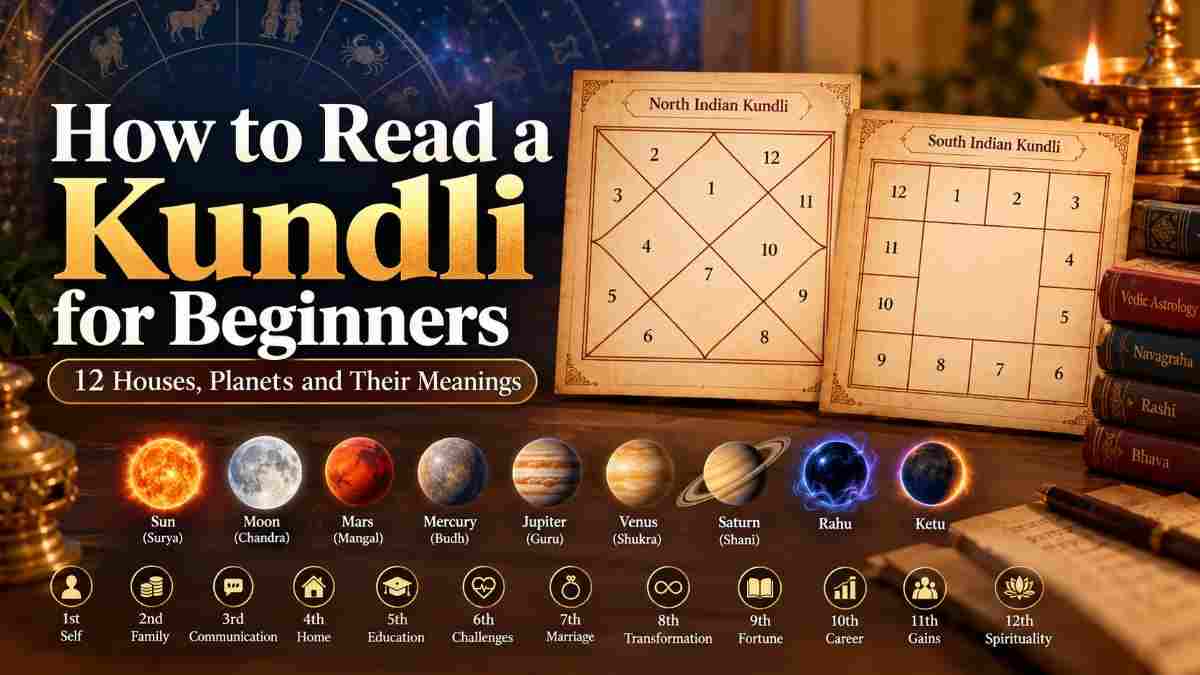
A Kundli, also known as a Janam Kundli or birth chart, is one of the foundational tools used in traditional Vedic astrology. It represents the calculated positions of celestial bodies and zodiac signs at the time of a person's birth.
For beginners, learning how to read a Kundli can seem complicated. The chart contains twelve houses, twelve zodiac signs, nine grahas, planetary rulerships and several traditional interpretation rules.
However, Kundli reading becomes easier once you understand its structure.
To read a Kundli, start by identifying the Lagna or Ascendant, understand the twelve houses, locate the planets and zodiac signs, and then examine house lords and planetary relationships.
This guide explains these concepts step by step, including the differences between North Indian and South Indian birth chart formats.
If you want to understand how traditional astrological interpretations are applied to an individual birth chart, Astro Aashirvaad also discusses this approach through its astrology consultation and Kundli analysis guidance.
A Kundli is a chart used in Vedic astrology, also known as Jyotish Shastra. It is prepared using a person's birth date, birth time and birthplace.
In traditional Indian astrology, the birth chart is interpreted through the symbolic relationships between planets, signs and houses.
Astrologers commonly examine the chart when discussing traditional themes related to:
These are traditional astrological associations rather than scientifically established methods for predicting events or personal characteristics.
Three essential details are used to construct a birth chart:
The birth time and location are particularly important for calculating the Ascendant and house positions.
Even a relatively small difference in birth time can change certain chart details, particularly near the transition between two rising signs.
Different calculation settings, including the ayanamsa and house system, may also influence the resulting chart.
Lagna, or the Ascendant, is the zodiac sign rising on the eastern horizon at the calculated birth time and location.
In traditional Vedic astrology, Lagna is an important starting point because it establishes the relationship between zodiac signs and the twelve houses.
In the commonly used whole-sign house approach, the Ascendant sign becomes the first house, and the remaining signs follow in zodiacal order.
For example, if Aries is the Ascendant, Aries becomes the first house, Taurus the second house and Gemini the third house.
The planet ruling the Ascendant sign is called the Lagna Lord.
For an Aries Ascendant, Mars is the Lagna Lord. For a Taurus Ascendant, Venus is the Lagna Lord.
Traditional Kundli interpretation frequently considers the Ascendant, its ruling planet and their relationships with the rest of the chart.
The twelve houses of a Kundli are called Bhavas. Each house is associated with different areas of life within traditional Vedic astrology.
Understanding the basic meanings of these houses is one of the first steps in learning Kundli reading.
| House | Traditional Name | Main Significations |
|---|---|---|
| 1st House | Lagna / Tanu Bhava | Self, identity, appearance and temperament |
| 2nd House | Dhana Bhava | Family, speech, savings and accumulated resources |
| 3rd House | Sahaja Bhava | Courage, communication, siblings and initiative |
| 4th House | Sukha Bhava | Home, mother, property and emotional comfort |
| 5th House | Putra Bhava | Education, intelligence, creativity and children |
| 6th House | Ari / Ripu Bhava | Competition, service, debts and disputes |
| 7th House | Kalatra Bhava | Marriage, partnerships and relationships |
| 8th House | Randhra / Ayu Bhava | Transformation, inheritance and hidden matters |
| 9th House | Dharma Bhava | Higher learning, beliefs, teachers and fortune |
| 10th House | Karma Bhava | Career, public responsibilities and reputation |
| 11th House | Labha Bhava | Gains, friendships, networks and aspirations |
| 12th House | Vyaya Bhava | Expenditure, isolation, foreign connections and spiritual retreat |
Every house has its own symbolic importance. However, a traditional interpretation also considers the relevant house lord, planetary placements and aspects.
The first house is associated with identity, self-expression, physical appearance and general temperament.
It is also the reference point from which the other houses are counted.
The second house is traditionally associated with family, speech, accumulated wealth and personal resources.
Astrologers may examine this house alongside other financial houses when discussing money-related themes.
The third house is associated with communication, courage, personal initiative, siblings and practical skills.
It is commonly examined in traditional interpretations involving effort and self-expression.
The fourth house represents themes connected with home, domestic life, property, mother and emotional comfort.
Its traditional interpretation considers the house ruler and any planets influencing it.
The fifth house is associated with education, creativity, children, intelligence and speculative interests.
Some traditional schools also associate this house with mantra practice and spiritual learning.
The sixth house is linked with competition, service, debts, disputes and everyday challenges.
It is sometimes associated with health-related themes in astrology, but planetary placements cannot diagnose medical conditions.
The seventh house is traditionally associated with marriage, committed partnerships and business relationships.
In marriage-related Kundli interpretations, astrologers may consider the seventh house, its ruler, Venus, Jupiter and other traditional chart factors.
People researching relationship compatibility may also explore Astro Aashirvaad's love marriage and relationship guidance, which discusses communication, compatibility concerns and practical relationship challenges.
The eighth house is associated with major changes, transformation, inheritance, longevity and matters that are not immediately visible.
It should not automatically be considered negative because traditional interpretations depend on the complete chart.
The ninth house is traditionally connected with higher education, philosophy, dharma, teachers, beliefs and fortune.
It is often discussed in relation to knowledge, guidance and personal values.
The tenth house, known as Karma Bhava, is associated with profession, public responsibilities, career interests and reputation.
Astrologers commonly examine the tenth-house ruler and related placements in traditional career interpretations.
Actual professional progress, however, depends on practical factors such as education, skills, work experience and opportunities.
The eleventh house is associated with gains, friendships, wider networks, aspirations and the fulfillment of goals.
It is often considered alongside the second and tenth houses when discussing financial themes in traditional astrology.
The twelfth house is traditionally associated with expenditure, distant places, foreign connections, isolation, rest and spiritual retreat.
Its meaning depends on the broader chart, so it should not be interpreted as inherently unfavorable.
Vedic astrology divides the zodiac into twelve signs called Rashis. Each Rashi has a traditional planetary ruler.
| Number | Zodiac Sign | Hindi Name | Ruling Planet |
|---|---|---|---|
| 1 | Aries | Mesh | Mars |
| 2 | Taurus | Vrishabh | Venus |
| 3 | Gemini | Mithun | Mercury |
| 4 | Cancer | Karka | Moon |
| 5 | Leo | Simha | Sun |
| 6 | Virgo | Kanya | Mercury |
| 7 | Libra | Tula | Venus |
| 8 | Scorpio | Vrishchik | Mars |
| 9 | Sagittarius | Dhanu | Jupiter |
| 10 | Capricorn | Makar | Saturn |
| 11 | Aquarius | Kumbh | Saturn |
| 12 | Pisces | Meen | Jupiter |
These are the conventional sign rulerships used in many classical Vedic astrology approaches.
The nine grahas, collectively called Navagraha, are central to traditional Vedic astrology.
They include the Sun, Moon, five visible planets and the lunar nodes Rahu and Ketu.
Rahu and Ketu are not physical planets. They are mathematical points associated with the Moon's orbital nodes.
| Graha | Traditional Symbolic Associations |
|---|---|
| Sun (Surya) | Identity, authority, leadership and vitality |
| Moon (Chandra) | Mind, emotions, sensitivity and nurturing |
| Mars (Mangal) | Action, energy, courage and conflict |
| Mercury (Budh) | Communication, learning, reasoning and commerce |
| Jupiter (Guru) | Wisdom, teaching, knowledge and guidance |
| Venus (Shukra) | Relationships, beauty, comfort and artistic interests |
| Saturn (Shani) | Discipline, patience, responsibility and persistence |
| Rahu | Ambition, unconventional interests and worldly attachments |
| Ketu | Detachment, introspection and spiritual inquiry |
These characteristics represent traditional beliefs about the grahas rather than scientifically verified influences on human lives.
The easiest approach for beginners is to examine one part of the chart at a time.
Locate the Ascendant sign marked in the Kundli.
Its position establishes the first house in commonly used Vedic chart systems.
Make sure you are using the correct chart format before identifying the houses.
Find the twelve Rashis and note the sign occupying each house.
In a North Indian chart, sign numbers change depending on the Ascendant.
In a common South Indian chart, the zodiac signs are placed in fixed positions, and house counting starts from Lagna.
Identify where the nine grahas appear in the birth chart.
Record each planet's zodiac sign and house placement.
For example, if Jupiter is in the fifth house, a traditional astrologer may examine the fifth house's themes of knowledge and education alongside Jupiter's symbolic associations.
That placement alone is not sufficient for a complete interpretation.
Every zodiac sign has a ruling planet.
The ruler of the zodiac sign occupying a particular house is known as that house's lord.
For example, if Taurus occupies the second house, Venus becomes the second-house lord.
Traditional interpretations consider where the house lord is placed and its relationships with other planetary factors.
Planetary aspects are called Drishti in Vedic astrology.
In a commonly used Parashari approach, grahas generally aspect the seventh house from their position, while Mars, Jupiter and Saturn have additional special aspects.
Different astrological schools may use different aspect rules.
A single house or planetary placement does not represent the entire chart.
Traditional astrologers may also consider:
Astro Aashirvaad's birth chart analysis and astrology guidance page discusses how traditional chart interpretations may be considered alongside practical decision-making.
The North Indian Kundli commonly uses a diamond-shaped chart.
Its house positions remain fixed, while the zodiac signs appearing in those positions change according to the Ascendant.
The numbers generally represent zodiac signs, not house numbers.
For example:
If the first house contains the number 4, it indicates Cancer Ascendant.
It does not mean that the first house is the fourth house.
Understanding this distinction can prevent one of the most common mistakes in North Indian Kundli reading.
A South Indian Kundli commonly uses a rectangular format with twelve zodiac sign positions.
In this format, zodiac sign positions remain fixed.
The Ascendant sign is marked within the chart, and houses are counted from that sign.
For example, when Leo is the Ascendant in a whole-sign approach, Leo becomes the first house, Virgo the second and Libra the third.
North Indian and South Indian formats can represent the same underlying planetary placements even though their visual arrangements differ.
Lagna, Rashi and Nakshatra refer to different concepts in traditional Vedic astrology.
| Term | Meaning |
|---|---|
| Lagna | The Ascendant sign rising on the eastern horizon at birth |
| Rashi | A zodiac sign; Janma Rashi commonly refers to the Moon sign |
| Nakshatra | One of the 27 traditional lunar mansions used in Vedic astrology |
A person's Ascendant and Moon sign may be different.
The Moon's Nakshatra is also used to determine the starting planetary period in the traditional Vimshottari Dasha system.
Mahadasha refers to a major planetary period used in certain Vedic astrology systems.
Vimshottari Dasha is one of the most widely used systems. Its traditional cycle consists of 120 years divided among nine grahas.
Each Mahadasha contains smaller subperiods called Antardashas.
Astrologers examine these periods as part of their traditional interpretations of life themes and timing.
However, these interpretations have not been scientifically established as reliable methods for predicting events.
Marriage compatibility is one of the traditional applications of Kundli interpretation.
In some Vedic astrology practices, astrologers consider the Moon signs, Nakshatras, Ashtakoota matching and other chart factors.
Ashtakoota matching traditionally allocates a maximum of 36 points across eight compatibility categories.
However, a numerical score is not a scientifically validated measure of relationship success.
Communication, trust, mutual consent, shared expectations and practical compatibility remain essential in any relationship.
For more information about navigating relationship concerns, Astro Aashirvaad provides love marriage guidance in Bangalore, covering topics such as family resistance, communication and compatibility.
Beginners often misunderstand the chart because they try to interpret advanced combinations without understanding the fundamentals.
Common mistakes include:
A better learning approach is to first understand signs, houses and planetary placements before moving to more complex traditional calculations.
Yes. Beginners can learn the foundations of traditional Kundli reading through structured study and regular practice.
Start with:
A traditional astrologer can explain how a particular interpretive method is applied, but astrology should not replace evidence-based professional advice for important medical, financial or legal decisions.
When comparing practitioners, it can be useful to understand their approach to confidentiality, practical guidance and realistic expectations. Astro Aashirvaad discusses these considerations on its trusted astrologer in Bangalore page.
Begin by understanding the Lagna, twelve houses, twelve Rashis and nine grahas. Once you can identify their positions, study planetary rulerships and aspects.
The first house and Ascendant are central starting points in many Vedic astrology systems. However, all twelve houses have different meanings and are considered together in traditional interpretations.
In common North Indian chart notation, the number 1 represents Aries or Mesh Rashi. It does not automatically indicate the first house.
No. Lagna is the Ascendant sign. In common Indian usage, Janma Rashi often refers to the zodiac sign occupied by the Moon at birth.
Kundli interpretation is a traditional belief system. Scientific evidence does not establish it as a reliable way to predict specific future events or life outcomes.
An inaccurate birth time can change the Ascendant, house placements and certain traditional timing calculations. Use the most reliable available birth record when preparing a chart.
Kundli generally refers to a detailed birth chart, while horoscope can refer to a natal chart or a broader astrological forecast.
No. Rahu and Ketu represent the Moon's ascending and descending orbital nodes, which are mathematical points rather than physical planets.
Kundli matching is a traditional astrological method of comparing birth charts, often in the context of marriage. Different schools examine compatibility using criteria such as Nakshatra relationships, planetary placements and the Ashtakoota system.
Professional consultation is not necessary to learn the basic structure of a Kundli. People interested in traditional interpretations may choose to speak with an astrologer, while retaining responsibility for their own decisions.
Learning how to read a Kundli begins with understanding its structure rather than trying to predict events immediately.
The Lagna establishes the starting point, the twelve houses represent different traditional life themes, and the planetary positions form the basis of further interpretation.
With practice, beginners can become familiar with zodiac signs, house lordships, planetary relationships and the terminology used in Vedic astrology.
Astro Aashirvaad shares traditional astrology-related guidance and information about birth chart analysis, relationships and personal concerns.
If you would like to ask about its astrology consultation services or discuss a traditional Kundli interpretation, you can contact Astro Aashirvaad to enquire about the available guidance.
Listen to real experiences from our clients as they share their personal journeys of overcoming life's deepest obstacles. From breaking free of toxic negative energies with expert black magic removal to restoring broken relationship bonds through protective spiritual solutions, these heartfelt testimonials showcase the profound impact of genuine guidance.
My relationship was on the verge of breaking up completely due to severe misunderstandings and intense family opposition regarding our love marriage. I felt utterly helpless until I sought guidance here. The specialized love problem solutions and planetary alignments completely shifted the energy. Today, my partner and I are happily married with our families' full blessings. Truly a life-saving experience!
Rahul Sharma, Delhi

For over a year, our home felt incredibly heavy, and my health was deteriorating for no medical reason. We were facing constant, unexplained financial blockages. After a deep spiritual analysis, we discovered presence of strong negative energies. The black magic removal rituals performed brought immediate peace back into our house. Within a week, the heavy atmosphere vanished, and my health restored completely.
Priya Patel, Mumbai
Constant arguments and third-party interference had ruined my married life to the point where we were discussing legal separation and divorce. Out of desperation, I tried the relationship healing and cosmic balancing remedies. The results were miraculous. The bitterness between my husband and me completely dissolved, reviving our original love and mutual respect. I cannot thank you enough for saving my family.
Anjali Desai, Ahmedabad
My business went into a sudden, massive downfall out of nowhere, leaving me drowning in debt. I couldn't understand what went wrong until my birth chart was analyzed and malefic planetary transits were identified. The custom gemstone recommendations and business progress rituals turned everything around. My client flow is back, and the business is growing faster than ever before.
Vikram Malhotra, Bangalore
Our family was torn apart by a bitter property and relationship dispute that dragged on for years, causing immense stress to everyone involved. The peaceful energy alignment and ancestral cleansing solutions worked wonders. Within a short time, minds softened, communication lines reopened, and the entire dispute was resolved amicably. It brought genuine harmony back to our lives.
Sandeep Joshi, Jaipur

